Basement Tier: Inside the Garage-Door Con Scene Gen Z Is Running Out of Ohio
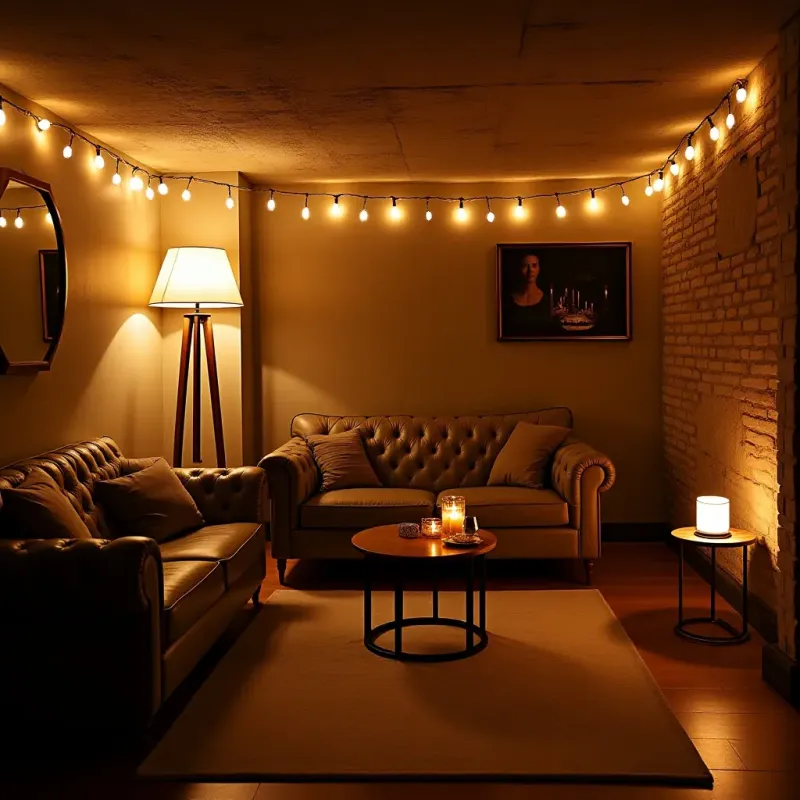
Photo: dark suburban basement gathering string lights folding table projector, via maggiemeadow.com
The flyer has no address. It has a Discord server, a password, and a rule that gets repeated in every channel like scripture: no screenshots, no coordinates, no clout.
That's the whole security apparatus for an event that, by conservative estimate, will put forty people and roughly three hundred explicit doujinshi in the same finished basement in suburban Dayton this Saturday night.
The Scene Nobody's Supposed to Photograph
Call them what the organizers call them — "house cons," "basement tiers," "garage meets" — and you'll find variations of the same thing happening in Kansas City cul-de-sacs, Tulsa split-levels, and the kind of Ohio town where the mall died but the teenagers didn't. Invite-only. Usually under-21-heavy. Almost always organized by people who've never held a vendor badge in their lives.
The format is dead simple. Someone's parents leave town or, more often, simply know better than to come downstairs. A folding table becomes artist alley. A projector and a rented HDMI cable become the screening room. A dresser drawer becomes the "18+ check," because even in a house party, the person running the table wants to see an ID.
"It's literally just a con with worse lighting and better snacks," says Mika, 19, who runs a quarterly swap meet out of her family's garage in the Toledo exurbs. (Organizers asked to be identified by first names or handles only — more on that in a second.) "We have a binder. We have a raffle. We have a guy who drives in from Detroit with two suitcases of stuff he's been collecting since middle school. What are we missing besides a Hyatt?"
Why the Basement, Though
The obvious answer is money. A table at a mid-size Midwest anime convention runs $75 to $150, hotel not included, and the adult-adjacent programming at those cons has been getting quietly squeezed for years. But the people building this scene aren't only fleeing the big cons — they're building something the big cons structurally can't offer.
For one thing, there's the honesty problem. At a mainstream con, adult content lives in a roped-off corner with a volunteer who's seen things. In a basement, it's just the premise. Nobody's pretending the doujinshi are "art books." Nobody whispers the word hentai. The event is what it is, and the social friction that defines adult fandom at scale — the shuffling, the discreet bags, the performative embarrassment — mostly evaporates.
"The first time I went to one, I kept waiting for the catch," says Dre, 20, who helps organize a screening night series in the Minneapolis suburbs. "And the catch is that it's in a basement and there's a golden retriever. That's it. That's the catch."
There's also a generational thing happening. Gen Z organizers grew up on Discord, on ephemeral group chats, on the understanding that online spaces are temporary and surveilled. A physical, password-protected, forty-person event isn't a downgrade from the internet. It's an escape from it.
PayPal Doesn't Return Your Calls
Here's where the romance meets the paperwork. These events exist in the gray zone of every payment processor, social platform, and municipal ordinance they touch.
PayPal freezes are the war story everyone has. "Sold raffle tickets to cover snacks, account locked in nine hours, held for 180 days," one organizer tells me. "Learned that lesson forever. We're a cash-and-Venmo operation now, and even Venmo makes me nervous." Because adult-adjacent transactions violate most processors' terms of service even when the money is technically for chips and pop, organizers have gotten creative: "art commissions," "zine pre-orders," the world's most transparent euphemisms.
Platform bans are the other tax. Event pages get nuked from Eventbrite. Discord servers get reported and yoinked. Instagram accounts with even mildly suggestive promo art get shadowbanned into silence. The result is a scene that communicates almost entirely through private channels — Signal groups, invite codes passed at other cons, a friend-of-a-friend vouching system that would feel paranoid if it didn't work so well.
And then there's the neighborhood. A rotating crowd of twenty-somethings carrying black duffel bags into a suburban garage every few months generates exactly the curiosity you'd expect. Most organizers handle it with Midwestern pragmatism. "My neighbor asked if we were a church group," Mika laughs. "I said 'kind of.' He helps us set up folding chairs now. I'm not proud, but I'm not lying to him either."
What This Says About American Fandom
Strip away the novelty and the basement con scene is a stress test of adult fandom's future, and the early results are revealing.
It proves there's demand for adult anime community that doesn't route through a corporation. Every platform these organizers depend on — Discord, PayPal, Instagram — has demonstrated it will drop them the moment it's convenient. The basement scene is what fandom looks like when you assume the infrastructure will fail you and build accordingly: cash-first, in-person, trust-based, deliberately small.
It also suggests the age wave is real. The under-25 crowd isn't waiting for permission from the conventions that raised the rest of us. They're treating adult hentai fandom not as a shameful sub-hobby but as a default setting, something you can organize around a kitchen table without a crisis of identity.
Will it scale? Almost certainly not, and that's the point. The moment a basement tier gets big enough to attract a local news crew, it dissolves and reconstitutes two towns over under a new Discord handle. It's fandom as mycelium — invisible, resilient, everywhere.
Saturday night in Dayton, the projector hums, the raffle bucket fills with crumpled fives, and somebody's mom texts down to ask if anyone wants pizza. The future of American adult fandom, it turns out, smells faintly of cardboard boxes and microwave popcorn.
And it doesn't need your address.