The 11:48 Train Is Never Empty: Density, Distance, and the Hentai Daydream
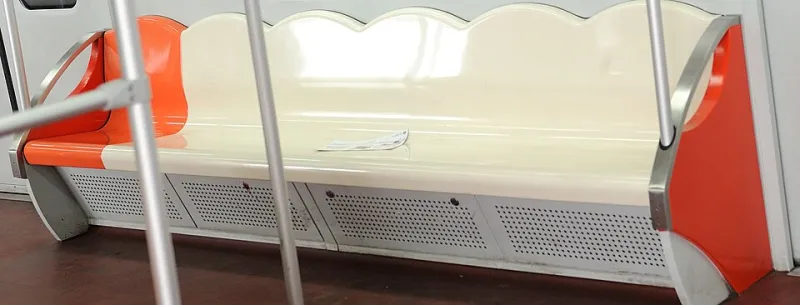
Photo: Tim Adams, CC BY 2.0, via Wikimedia Commons
There's a moment that shows up in roughly a thousand hentai titles: the last train home, packed shoulder to shoulder, everyone pretending not to notice anyone. If you grew up riding the L, BART, or the A train at rush hour, you know the feeling. If you grew up in a suburb where the closest thing to public transit was the school bus, you know it too — just secondhand, through a screen.
That gap is the whole secret. Hentai's settings are mundane to the point of boredom for Tokyo commuters, and they're exotic for exactly the same reason to someone in a cul-de-sac in Ohio.
The Fantasy of Being Close
American cities, with a handful of exceptions, are built around distance. You drive to work, drive to the store, drive home to a detached house with a yard and a lock on the door. Privacy isn't a luxury; it's the default. Which means anonymity in a crowd — that electric, uncomfortable closeness of strangers pressed together — is something most of us almost never experience.
Japan's urban density flips that. Apartments the size of American garages. Trains so packed that station staff get paid to push people aboard. Convenience stores on every corner, lit up at 3 a.m. like beacons. When hentai stages an encounter on a crowded subway car or in a shared apartment with paper-thin walls, it's drawing on a lived reality where bodies are simply around all the time.
For an American viewer, that's not relatable — it's aspirational. The crowded train isn't a memory of your Tuesday commute. It's a fantasy about a world where proximity is unavoidable, where the city itself conspires to put people too close together.
Convenience Stores at the Edge of Night
Think about how many scenes open with a fluorescent-lit konbini run. Late shift, empty aisles, the hum of drink coolers. There's a whole grammar to it: the exhaustion, the anonymity, the sense that the rules loosen after midnight.
Compare that to the American late-night space — the gas station off the interstate, the 24-hour Walmart. Functionally similar, but the texture is different. A Japanese convenience store is embedded in a walkable neighborhood, a five-minute errand. An American one is a destination you drive to, alone, in your car. The hentai konbini scene works because the city is right there, breathing over your shoulder. The gas station works because nothing is.
Writers and directors in the genre understand this instinctively. The setting does half the erotic work. A cramped apartment means you can hear your neighbor. A school rooftop means you're above the city but still inside it. The train means a fixed schedule, a countdown, a window of opportunity that closes when the doors chime.
The Rooftop as Escape Hatch
School rooftops deserve their own paragraph, because they're the genre's most persistent location and the one that confuses American viewers most. We locked our rooftops decades ago — liability, jumping scares, insurance. Japanese schools, at least in fiction, keep them open, and they function as the one semi-private outdoor space in a city with no yards.
So the rooftop scene is doing double duty. It's transgressive (skipping class, breaking rules) and it's intimate (the whole skyline as backdrop, no one else up there). For American audiences, it reads as pure fantasy — a private balcony in the sky that most of us have never had access to, in any building, ever.
Sprawl Makes Its Own Kinks
None of this means American viewers lack urban imagination. Our sprawl produces its own fantasies — the roadside motel, the car at the overlook, the rest stop. But those are fantasies about escape, about driving away from everything. Hentai's fantasies are about confinement, about being stuck in a space with someone and having nowhere to go.
That inversion might be the genre's deepest hook for a US audience. We built a country where you can always leave. Hentai builds a world where you can't — and where, for forty minutes of runtime, that's not a nightmare. It's the point.
The next time a scene opens on a packed morning train, notice what your brain does. If there's a little flicker of I've never been anywhere like that underneath everything else — that's not an accident. That's a Tokyo apartment block, translated through a screen, landing in a living room in Kansas. Density, it turns out, exports really well.